
 Many organisational challenges persist because of how the problem is approached, not because of a lack of capability.
Most organisations don’t lack intelligence, capability or data. The challenge is that established ways of thinking are often applied to problems that require a different perspective.
Same thinking, less progress
Our clients tell us that their people expect AI to solve problems and that human thinking within their businesses is often dominated by analysis, judgment and debate. These are important disciplines. But over time, they can create unintended constraints:
- The same voices dominate discussions.
- Ideas are tested before they are explored.
- Problems become narrowly defined.
- Assumptions harden into accepted truths.
The result is that their organisations become highly effective at defending existing positions, while making less progress on the problems that matter most.
The problems conventional thinking struggles to solve
Some challenges simply don’t respond to analysis alone:
- Persistent operational issues that repeatedly return, despite multiple interventions.
- Strategies that evolve incrementally when the market demands clear differentiation.
- Cross-functional challenges where departments approach the same issue from entirely different perspectives.
- Innovation efforts that produce ideas that are either too cautious to matter or too impractical to implement.
These are not capability problems. They result from applying familiar patterns of thinking to unfamiliar or complex situations.
What Lateral Thinking changes
Lateral thinking, developed by Edward de Bono, is designed to challenge established patterns of perception, before moving to judgment or decision-making.
Instead of asking: “What is the right answer?”
It asks: “What might we be missing?”
That shift matters!
It creates the space to:
- Challenge assumptions that are no longer useful.
- Explore alternatives before narrowing options.
- Move discussions beyond opposition and debate.
- Generate approaches that would not emerge through conventional analysis alone.
What this looks like in practice
- Teams that use lateral thinking techniques can:
- Approach complex problems with greater flexibility.
- Surface assumptions earlier.
- Reduce circular discussions.
- Involve a broader range of perspectives in decision-making.
- Develop ideas further before dismissing them.
Most importantly, they become better at identifying the real problem, not improving the existing response to it.
Why this matters now
The pressures facing organisations are becoming more interconnected, fast-moving and ambiguous. More information does not automatically produce better decisions, speed can reduce the quality of thinking and complex problems rarely sit neatly within one function or discipline.
AI can accelerate access to information, produce fast answers and efficient shortcuts, but it cannot replace critical thinking, challenge assumptions or generate genuine innovation. Organisations still need people who can think differently, question established patterns and explore possibilities beyond the obvious.
In this environment, organisations that can rethink assumptions, explore alternatives and adapt their thinking gain a significant advantage.
Bringing this into your organisation
Lateral thinking is not abstract theory or creativity training detached from commercial reality. It is a practical discipline that can be applied to strategy, problem-solving, decision-making and innovation.
Our workshops help teams:
- Apply Lateral Thinking tools to real business challenges.
- Develop more flexible and constructive ways of thinking.
- Improve both idea generation and decision quality.
- Build confidence in tackling complex or unclear problems.
If your organisation is facing challenges that persist despite capable people and significant effort, the issue may not be execution. It may be the way the problem is being approached.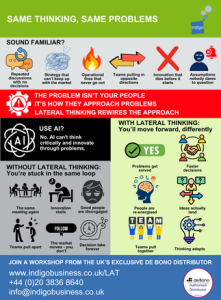
- Find out more about Lateral Thinking.
- Download our 1-page guide: Same thinking, same problems.
- Training you – public workshops throughout the UK and online.
- Training your team – in-house workshops for groups or teams.
- Training your organisation – training your trainers to deliver Lateral Thinking.