
 LinkedIn’s CEO just challenged one of the biggest assumptions about work: the skills that matter most aren’t technical. It’s a striking claim from the leader of a platform built on job titles, qualifications and professional credentials – one we think is worth listening to.
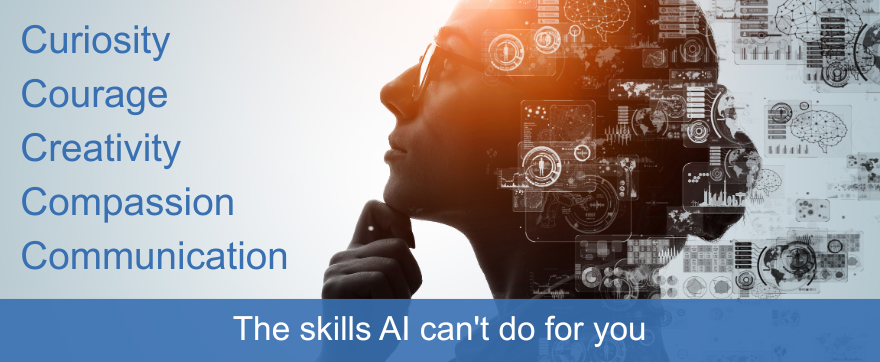
In their new book, ‘Open to Work: How to Get Ahead in the Age of AI’, Ryan Roslansky (LinkedIn’s CEO and a Microsoft EVP) and Aneesh Raman (LinkedIn’s Chief Economic Opportunity Officer) argue that as AI takes on more routine and technical work, five human capabilities become the real differentiators. They call them the 5Cs: Curiosity, Courage, Creativity, Compassion and Communication.
We think Roslansky and Raman are right, but perhaps for an even bigger reason than they suggest. As AI becomes available to everyone, technical capability becomes easier to access. The competitive advantage shifts to the people who ask better questions, make better decisions, build stronger relationships and inspire others to act.
So what does developing those capabilities actually look like?
Curiosity
Roslansky and Raman describe curiosity as the drive to ask, “what if we tried something completely different”, rather than simply processing what already exists.
In an AI-enabled workplace, curiosity becomes even more valuable. When everyone has access to the same tools, the differentiator isn’t who writes the best prompt – it’s who asks the best questions in the first place. Curious people challenge assumptions, spot opportunities others miss and experiment with new ways of working.
That kind of mindset doesn’t emerge from technology alone. It grows in organisations that encourage learning, exploration and thoughtful experimentation.
Courage
The book frames courage as the willingness to act without complete information, to speak up, to make decisions and to take responsibility when there isn’t a perfect answer.
That’s increasingly what leadership looks like. Whether it’s answering an unexpected question in a meeting, handling a difficult conversation or making a decision amid uncertainty, preparation only gets you so far. Eventually, you have to think clearly under pressure.
That’s exactly what Think on Your Feet® develops: practical techniques for structuring ideas and communicating clearly when you’re put on the spot.
For leaders who also need to influence larger audiences, The Complete Presenter™ builds the confidence and composure to communicate persuasively, even when the presentation doesn’t go according to plan.
Creativity
Creativity, the authors argue, isn’t confined to designers or marketers. It’s the ability to imagine possibilities that didn’t exist before, not simply remix what’s already available.
Ironically, the rise of generative AI makes human creativity even more valuable. AI is excellent at producing variations on existing patterns. But it still relies on people to define the problem, reframe the challenge and recognise genuinely original ideas.
That’s why structured creative thinking matters.
de Bono’s Lateral Thinking® gives individuals and teams practical tools for generating fresh ideas on demand. Combined with Six Thinking Hats®, which helps teams evaluate ideas from multiple perspectives and make better decisions together, it creates a disciplined approach to innovation rather than hoping inspiration will strike.
Compassion
Compassion may be the most underrated of the five Cs, yet it’s arguably the one that makes the biggest difference to how people experience work.
It’s the manager who notices someone struggling before performance drops. The colleague who understands why a conversation isn’t landing. The leader who builds trust during periods of uncertainty rather than simply managing tasks.
As routine work becomes increasingly automated, relationships become more important, not less.
Insights® Discovery helps people understand both themselves and the people around them, creating stronger working relationships, better collaboration and more effective leadership.
Communication
Roslansky and Raman save perhaps their strongest point for last. Communication is now LinkedIn’s number one in-demand workplace skill, ahead of every technical discipline.
AI can generate words, translate languages and draft emails. Humans create understanding.
The ability to explain a complex idea simply, influence a decision, tell a compelling story or inspire action remains fundamentally human and increasingly valuable.
Great communication isn’t just about speaking confidently. It’s about organising your thinking so other people can follow it. Whether you’re answering an unexpected question, leading a meeting or presenting a recommendation, the ability to structure your ideas before you speak helps your audience understand your message, remember it and act on it.
Think on Your Feet® develops exactly that capability, giving people practical techniques to organise their thinking in real time and deliver messages with clarity, brevity and impact, even when they’re under pressure.
For written communication, Writing Dynamics™ helps people write with greater clarity and influence, including when AI is supporting the drafting process.
And when the challenge is presenting to a room rather than responding in the moment, The Skilled Presenter™ develops the techniques needed to communicate with confidence, credibility and impact, whether in person or online.
None of the 5Cs are new.
What’s new is hearing them championed by the company behind the world’s largest professional network.
Technical skills will always matter. But if Roslansky and Raman are right, and we believe they are, the organisations that invest only in technical capability will find it increasingly easy to replace what they have.
The organisations that invest in curiosity, courage, creativity, compassion and communication will build something much harder to automate.
AI is becoming everyone’s assistant.
The real competitive advantage is no longer who can produce work the fastest. It’s who can ask the best questions, make the best decisions and bring other people with them. Those are profoundly human capabilities.
And they’re exactly the capabilities organisations should be developing now.
If you’d like to explore how Indigo can help your people build the 5Cs, talk to us about creating a programme tailored to your team.
Source: Ryan Roslansky and Aneesh Raman, Open to Work: How to Get Ahead in the Age of AI. Published by Harper Business, an imprint of HarperCollins Publishers.